Home
Contact
Book my free water test 208-602-3161
  1. Home
  2. Products
  3. Tap water filters

Tap and drinking water filters

Tap And Drinking Water,
Filtered To The Test

Carbon for the chlorine taste on city supply, reverse osmosis at the kitchen tap for the dissolved load a softener can never touch, and whole home filters where a well needs them. We test first, then fit the filter to what the water is actually doing at your sink.

Meridian based. Ada, Canyon and Gem counties are our core area, plus Elmore, Payette, Owyhee, Boise, Valley and Washington by arrangement.

01

A filter and a softener are not
the same machine

A softener runs ion exchange. It trades the calcium and magnesium that scale your kettle and stiffen your laundry for a little sodium, and that is the whole of its job. It does nothing for the chlorine taste on city water, nothing for the dissolved solids a well carries, and nothing for nitrate. Anyone who tells you a softener cleans up all of that is selling, not testing.

A filter is a different tool for a different problem. Carbon pulls the chlorine taste and smell out of treated city supply. Reverse osmosis at the kitchen tap strips out the dissolved load that ion exchange was never built to reach. Most homes here end up wanting some of each, and the free test is what tells us where the line falls between them.

We are an authorized dealer for Hague Quality Water. Their flagship, the WaterMax, uses a patented three compartment design that puts softening and filtration stages in one cabinet sized to the household, which is why 96 percent of our clients choose it once they see how much a single unit will carry. We do not lead with the box, though. We lead with your numbers.

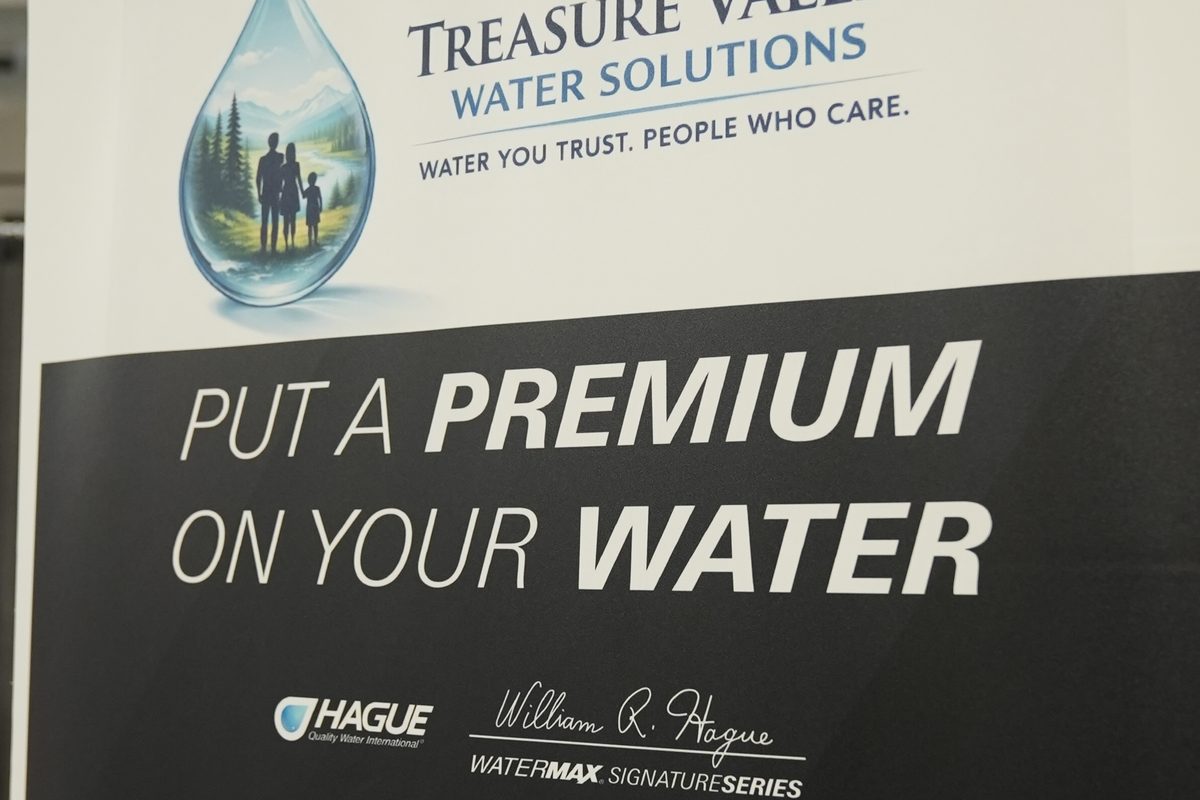
Hague WaterMax systems on display at a Treasure Valley event
Technician servicing a reverse osmosis unit under a kitchen sink

02

Reverse osmosis takes out what
a softener leaves behind

Reverse osmosis pushes your water through a membrane fine enough to hold back material dissolved right down at the molecular level. Where a softener only trades hardness minerals, an RO unit under the kitchen sink removes dissolved solids, nitrate and a long list of things besides, then feeds a dedicated little tap at the counter. You get clean water to drink and cook with, without paying to treat every gallon that runs to the toilet and the garden hose.

That matters most on a well. Nitrate has no taste, no smell and no color, so water well over the limit looks identical to water at zero, and a softener cannot remove a bit of it. Reverse osmosis at the drinking tap does, which is why we reach for it on wells near farmed ground. On city supply the win is plainer: RO takes the flat, treated taste out of a glass of water, and a lot of people never go back to the bottled jugs once they have it.

What each stage is actually doing

What removes what. A softener earns its keep on hardness, and on nothing else in this list.
What is in the waterWhat actually removes itCan a softener do it?
Chlorine taste and smell, city supplyCarbon, whole home or at the tapNo, it passes straight through
Nitrate, wells near farmed groundReverse osmosis at the tap, or dedicated mediaNo, needs its own treatment
Dissolved solidsReverse osmosis at the kitchen tapNo
Hardness, scale and spottingSoftener, ion exchangeYes, this is the job
Sediment and gritSediment cartridge ahead of the lineNo
Iron staining, wellsIron media, lab confirmed firstNo, and iron fouls the resin

03

Whole home carbon, sediment and iron,
before the water splits off

Reverse osmosis lives at one tap. Sometimes the problem is bigger than that. A carbon filter set on the main line takes the chlorine out at every fixture, so the shower stops drying your skin and the whole house tastes the same as that dedicated drinking tap. A sediment cartridge ahead of it catches the grit and fines that would otherwise chew through everything downstream, and on a well an iron stage keeps the orange staining off your laundry and off the softener resin behind it.

Iron, and anything past it, is a lab question. We field test at your sink, but iron, arsenic, uranium and nitrate all turn up on Treasure Valley wells and each needs a certified lab number before anyone talks hardware. We would rather send a sample out and wait than guess at a well and put the wrong media in front of your family.

One cabinet, or several tanks

The WaterMax is built so the stages can share one cabinet. Softening and filtration in a single unit, sized from your test rather than picked off a pallet, which is the tidy answer in a garage that does not have room for a row of tanks. Most clients land there once they see it, but not every house should, and we will say so if a separate drinking water unit is the honest call for your water. If the budget is the sticking point, ask about the rental program. Same equipment, same install standard, spread out instead of paid up front, so money never decides whether your family drinks filtered water.

Worth knowing

Carbon is the sneaky one. It does not clog and it does not slow down. It just quietly stops adsorbing, and the chlorine taste walks back through as if the housing were empty. That is why we set change intervals off your own test rather than a printed calendar, and why we retest at the tap after a swap instead of assuming. Get your water tested free

04

We size the filter off your test,
never off a shelf package

Everything on this page hangs off one visit. The free test is about thirty minutes at your kitchen sink, no charge and no obligation, and we run the samples in front of you instead of carrying them away and phoning in a verdict later. You watch the numbers come up, we read them out with you, and we leave the written sheet behind whether you buy anything or not. Take it to another company if you like. We would rather you compare.

On city water in Boise, Meridian or Nampa the story is usually straightforward. Hardness runs 8 to 15 grains per gallon, water is not soft until it drops under about 3, and there is a chlorine taste sitting on top of it, so a softener with carbon covers the house. On a well the picture is wider and the lab does the driving. What we do not do is decide the filter before we have seen the water, because a unit sized off a single strip reading is a unit running on water it was never built for.

"People expect us to show up with a clipboard and a price. We show up with a test kit. On a drinking water job the interesting result is rarely the hardness, it is the nitrate on a well nobody had checked, or a chlorine taste a simple carbon stage fixes for good."
Field note from the TVWS install crew, Meridian

The drinking water systems
we fit under the sink

Two Hague units cover most of the drinking water work we do here. Both sit in the cabinet under the kitchen sink and feed a dedicated little tap at the counter, and both are decided by what the test sheet says rather than by what we happen to have on the van. Sizes are listed below because cabinet space settles more of these jobs than people expect, especially where a waste bin and a disposal are already fighting for the same corner.

Hague H3500 five stage reverse osmosis drinking water system with storage tank and faucet

Most capable

H3500 Reverse Osmosis

Five stages under the sink, and the one we reach for when a lab report is the reason we are there. It is certified for fluoride, lead, arsenic and nitrate among others, which is the list that matters on a Treasure Valley well. A non electric pump fills the tank, and Hague states that is five times faster than a conventional system.

Stages
5
Output
Up to 50 gal per day
Storage tank
Up to 3 gallons
Certification
WQA Gold Seal
Warranty
25 year limited
Hague InterFlo QuadPro SST reverse osmosis system for under sink installation

Reverse osmosis

InterFlo QuadPro SST Reverse Osmosis

Three stages ending at a membrane, for water carrying more than a taste problem. This is the one we fit on wells near farmed ground, where the lab result comes back with nitrate on it. It needs more room in the cabinet than the cartridge filter, so we measure the space before we quote it.

Stages
3 stage
Size
5.5" W x 16.9" H x 17.5" D
Rated by Hague
60 percent efficiency, 74.5 percent recovery
Certification
WQA Gold Seal
Warranty
Limited warranty
Hague InterFlo drinking water filter, a slim under sink cartridge housing

Cartridge filter

InterFlo Drinking Water Filter

The straightforward answer where the test comes back clean apart from taste and smell. It is a cartridge unit in a slim housing, sold as the IF-14 and IF-15, feeding its own tap at the counter. Plan on a cartridge swap once or twice a year depending on how hard your water works it.

Models
IF-14 and IF-15
Size
3.25" W x 16" L x 3.5" D
Cartridge life
Up to 7,900 gallons, replace every 6 to 12 months
Certification
IAPMO Water Quality Platinum Seal
Warranty
Limited 1 year

Choosing between the two is a short conversation once the numbers are on the sheet. If the complaint is the chlorine taste on Boise, Meridian or Nampa city supply and nothing else turned up, the cartridge filter handles it and takes less room doing it. If nitrate is on the sheet, the answer is reverse osmosis, because a plain carbon cartridge does not remove nitrate at all and no change interval will alter that. Only the membrane holds it back at the tap. On a well we wait for the certified lab number before picking either one, since nitrate gives you no taste, smell or color to go on.

What people ask us about drinking water filters

No charge, no obligation

Find out what your drinking
water actually carries

Thirty minutes at your kitchen sink, anywhere across Ada, Canyon and Gem counties. We read the numbers out with you and leave the sheet behind, then fit the filter to what we found.